
Cladding or Render? Choosing an Exterior Finish for an Adelaide Home
The short answer
Cladding vs render is less a choice between two looks than a choice about the wall behind them. Render is a coating bonded to a substrate, so it inherits whatever that substrate does, movement included. Cladding is a separate layer fixed over a frame or battens, so it can be detailed to shed and drain water independently of the wall behind it. On most Adelaide sites the substrate, the soil and the exposure narrow the field well before taste gets a say.
Cladding vs render: what actually differs
Render is a coating
Render is applied wet and cures in place. Traditional cement-based renders and modern polymer-modified or acrylic systems all bond to something solid—brickwork, blockwork, AAC panels such as Hebel, or a proprietary base sheet fixed to a frame—and are then finished with a texture and a coating. There is no gap and no separation: the render and the wall behave as one element. That is the source of its best quality, a continuous monolithic face, and of its main weakness—anything the wall does eventually reaches the surface.
Cladding is a layer
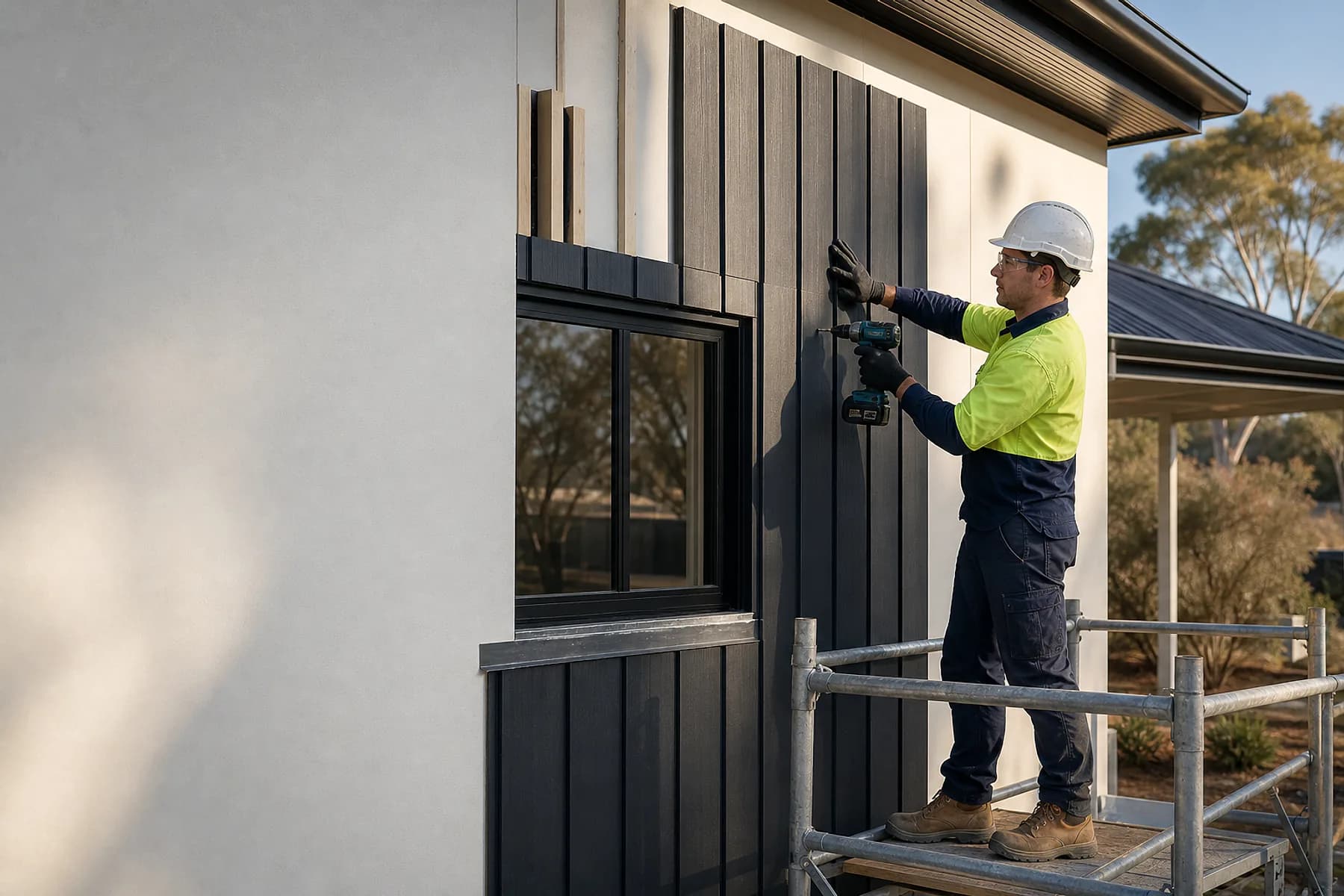
Cladding is fixed, not bonded. Boards, planks or sheets are screwed or nailed to the frame, usually over battens that create a drained and ventilated cavity, with a pliable membrane behind them doing the weatherproofing. Water that gets past the face has somewhere to go. The trade-off is that a clad wall lives or dies by its junctions: flashings at windows, doors, corners, the base of the wall and every penetration.
- Render is bonded to the substrate; cladding is fixed over it with a cavity and membrane behind
- Render gives one continuous plane; cladding gives an expressed joint pattern you have to design
- Render telegraphs substrate movement; cladding conceals it but relies on concealed flashings
- Render can only go on a substrate the system is documented for; cladding suits a frame directly
Sources: NCC 2022 Housing Provisions, Part 7.5 Timber and composite wall cladding, Australian Government YourHome, cladding systems and Rockcote, types of render.
Start with the wall you have
On a new build the frame and its sheeting settle most of it. A bare timber or steel frame cannot simply be rendered; render needs masonry, an AAC panel system or a documented render base sheet, and each of those changes the trade sequence long before anyone picks a colour. Cladding fixes to the frame more directly, which is why mixed facades so often clad the upper level and render the masonry below.
On an existing Adelaide home the question is sharper. Sound, unpainted brick veneer will take render well with the right preparation. The same wall can also be clad, but that becomes a battened, cavity-forming job with its own flashing requirements—our guide to cladding over brick covers what the existing wall has to confirm first.
Two conditions hold render up until they are resolved. Painted masonry turns the job into an adhesion question, which the rendering over painted brick guide works through. And where salt damp is present—common in older stone and brick homes across Adelaide’s inner suburbs—neither finish fixes it, and coating over it usually makes the damage worse.
Sources: Rockcote, preparing brick substrates for render and Dulux, Acratex substrate guides.
What Adelaide conditions change
Reactive clay soils run through much of the Adelaide plains, and they swell and shrink with the seasons. A rendered wall over a moving substrate shows it as cracking; a clad wall tends to show it at the joints instead. Neither is a remedy. Where a house has a movement history, have the cause understood—our guide to render cracking sets out what to record before anyone quotes a repair.
Coastal exposure at Semaphore, Glenelg and Brighton is harder on both systems, but in different places. On a clad wall the fasteners, flashings and coated boards carry the salt load; on a rendered wall the coating is the exposed layer. Durability requirements follow the documented exposure category and the manufacturer’s literature rather than the postcode, and the coastal cladding maintenance guide covers what that means in practice.
Hot dry summers matter mostly to render, because application and curing happen on site. Temperature, wind and drying conditions sit in each system’s product data sheet, and a summer programme should follow those documented limits. Up on the Hills Face side of town, bushfire-prone designation brings its own material requirements—the cladding comparison guide explains how that zoning is confirmed.
Whichever face goes on, the condensation provisions apply to the whole wall assembly rather than to the finish alone, and Adelaide sits in climate zone 5.
Sources: CSIRO, Foundation maintenance and footing performance (PDF), Rockcote, structural movement, NCC 2022 Housing Provisions, Part 10.8 Condensation management and the ABCB climate zone map, South Australia.
Upkeep, repair and how each ages
Neither finish is maintenance-free. The useful comparison is what fails first and how it gets repaired. A rendered wall is recoated on an interval set by the coating system and the exposure, with the manufacturer’s warranty terms usually setting the maintenance conditions that keep it valid—the repainting guide covers what the existing surface has to confirm first. Cracks are repairable, but the cause has to be settled before the cosmetic work, or the same line comes back.
A clad wall is washed down to the manufacturer’s schedule, and coated boards are repainted on their own cycle. Its advantage shows up in damage: a struck or split board is replaced individually, where the equivalent render repair is a patch matched into a continuous texture. Its disadvantage is that the parts that matter—membrane, flashings and cavity—are invisible once the boards are on, so defects there are found late.
Colour is a repaint either way. Both systems will change their look in ten years; neither will leave you alone for thirty.
Sources: Dulux, Acratex warranty, Rockcote maintenance guide (PDF) and James Hardie, fibre cement product information.
Approvals, scope and who carries the finish
Changing a building’s external appearance is exactly what a character or heritage overlay concerns itself with, and in South Australia whether planning consent is needed depends on how the work is categorised. Some work proceeds as accepted development with building consent only, but that category carries exceptions—heritage areas and the Hills Face Zone among them. Confirm the position for your allotment before material is ordered.
Trade scope is the other thing to settle in writing. On a clad wall, name who supplies and installs the membrane, the battens and every flashing, and who makes good at the windows. On a rendered wall, name who prepares the substrate, who sets the control joints and who owns the finish if the sheeting below it moves.
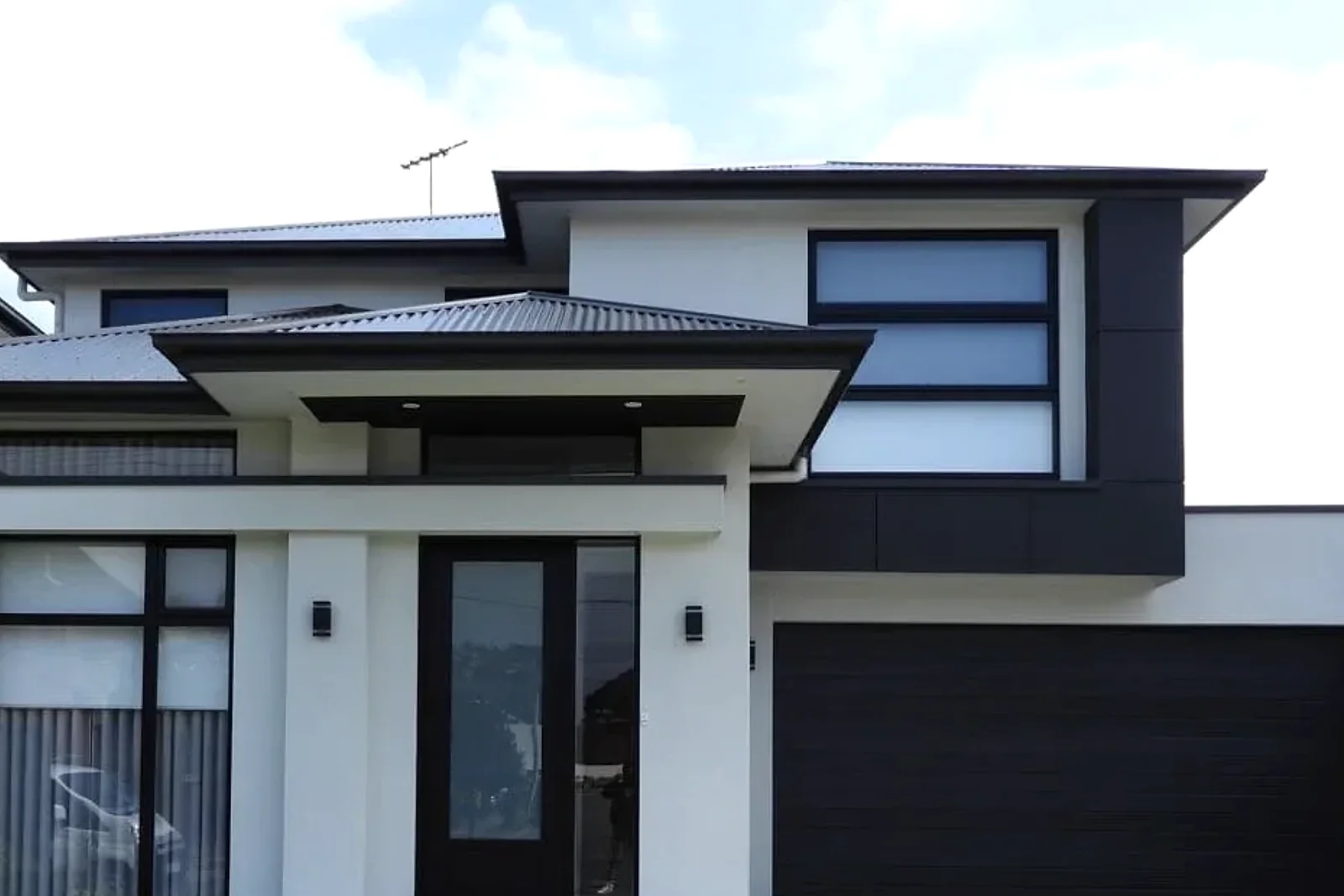
Our Adelaide cladding installation and rendering work often lands on the same elevation, because mixed facades are the common answer. The dark feature cladding case study shows how much the joint layout carries a clad finish, the two-storey render case study shows what a continuous rendered plane looks like across a whole facade, our project planning notes list what is useful to have ready before quoting, and the Adelaide service area page covers where we work.
Sources: PlanSA, find out if you need approval, PlanSA, types of consent and Government of South Australia, building work contractor’s licence.
Sensible next steps
Confirm what the substrate actually is
Brick veneer, solid masonry, AAC panel or a sheeted frame—and whether it has been painted before. That answer removes options faster than anything else.
Get the site classified before you commit
A geotechnical site classification tells you what the soil does. Settle the cladding vs render question after it, not before.
Check the overlays on your allotment
Heritage, character and Hills Face Zone provisions can shape the external appearance, so confirm the approval pathway before choosing a material.
Ask for the system documents, not the brochure
Whichever way you lean, ask for the manufacturer’s installation guide and warranty conditions for the specific system. They set the exposure limits and the maintenance terms.
Sources: SafeWork SA, silica in construction and SafeWork SA, working at heights.
Common questions
- Which one lasts longer?
- Service life belongs to the specific system and its exposure, not to the category. Maintained to their documented terms, both are long-life walls. The one that fails early is usually the one installed on the wrong substrate or detailed badly at the junctions.
- Can we use both on the same house?
- Yes, and it is common. Render on the masonry ground floor with cladding to an upper level or a feature element is a standard Adelaide approach. The junction between the two systems is the detail that has to be designed rather than improvised on site.
- Does cladding vs render change the insulation in the wall?
- It can. A clad wall with a batten cavity is a different assembly to a bonded render, and thermal and condensation performance is assessed across the whole build-up, not the finish. Where insulation or a membrane is being added, have the assembly designed as one thing.
- Will render hide the cracks already in our wall?
- Only until the wall moves again. Render bonded to a moving substrate reproduces the movement at the surface, so the cause needs assessment first. Covering it is the expensive way to find that out.
Sources and further reading
- Australian Building Codes Board
- NCC 2022 Housing Provisions, Part 7.5 Timber and composite wall cladding, Part 5.7 Weatherproofing of masonry, Part 10.8 Condensation management and the South Australian climate zone map
- Australian Government YourHome
- Cladding systems
- Government of South Australia
- PlanSA, find out if you need approval, types of consent and building work contractor’s licence
- SafeWork SA
- Silica in construction and working at heights
- Rockcote
- Types of render, preparing brick substrates for render, structural movement and the maintenance guide (PDF)
- Dulux
- Acratex substrate guides and Acratex warranty
- James Hardie
- Fibre cement product information