Repainting Rendered Walls in Adelaide: What to Check Before the First Coat
The short answer
Repainting render is mostly preparation. The coating you choose matters, but a sound, clean, properly primed wall is what decides whether the new finish lasts a decade or lifts in three years. Before any colour is picked, the existing surface needs to be assessed for adhesion, chalking, moisture and cracking—and the cracks in particular need to be understood rather than simply filled.
Assessing the existing surface
Repainting render starts with establishing that the surface is sound, stable and suitable for another coating. That assessment is the part homeowners most often skip, and it is the part that decides the specification.
- Whether the existing paint is firmly bonded, or lifting, flaking and powdery to the touch
- Whether the wall is dry, and whether anything is keeping it damp
- Dirt, mould, salt deposits and any organic growth that has to come off first
- Whether the substrate is cement render, acrylic render or a texture coat
- Previous repairs and patches, which can absorb differently from the wall around them
A previously painted or rendered surface often needs sealing, priming or patching before a new coat goes on, so that absorption is uniform and the new coating adheres properly. Where the existing coating is unknown—common on a house that has changed hands—the manufacturer’s technical literature for the proposed system sets out what test patches and preparation it requires.
Sources: Rockcote, Choosing the best paint for rendered homes and Dulux, Acratex preparation.
Cracks, patches and preparation
Minor hairline cracks can often be handled by a flexible, crack-bridging coating system. Structural cracking is different: it should be repaired before painting, and the movement causing it needs to be understood first. Reactive clay soils across the Adelaide Plains move seasonally, so cracking that appears in one part of the year and closes in another is telling you something a topcoat will not fix. Our guide to render cracking covers what to record before a repair is scoped.
Patching compounds and levelling renders exist precisely for this stage—products designed to bond to clean masonry and to shrink as little as possible while drying, so the repair does not read through the finished wall. Which one suits depends on the depth of the repair and the coating going over it, and the two need to be specified together rather than chosen separately.
Sources: Rockcote, Structural movement, Dulux, Acratex preparation and CSIRO, Foundation Maintenance and Footing Performance (PDF).
What Adelaide exposure does to a recoat
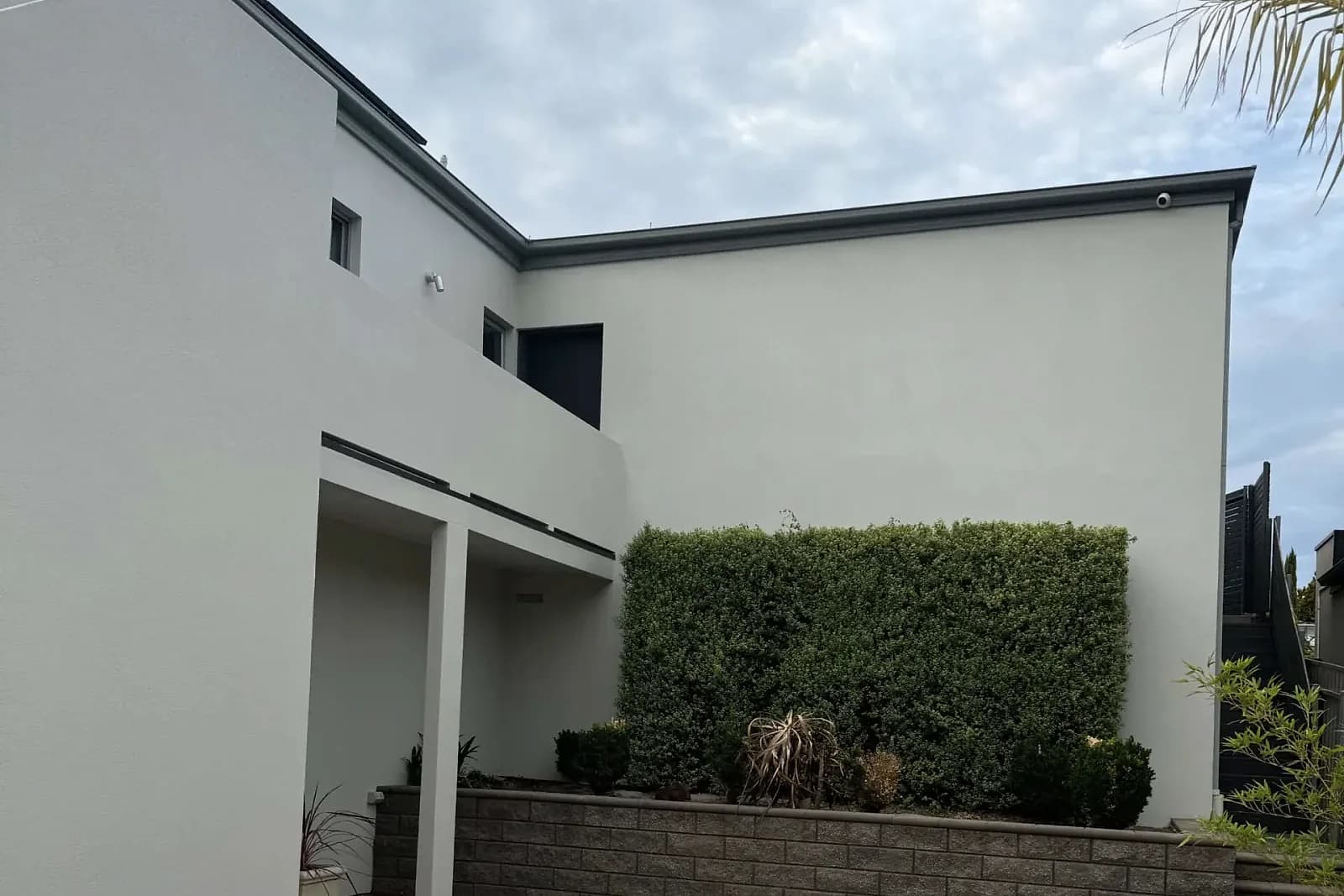
Maintenance cycles are not a fixed number of years. They depend on the colour, the exposure, the quality of the original application and the location—and dark colours and coastal environments both shorten them. A charcoal west-facing wall at Semaphore or Brighton is working far harder than a light north-facing wall in Salisbury East, and the two should not be on the same repaint schedule.
Long, hot, dry Adelaide summers push surface temperatures up on dark walls, and salt-laden air along the coast keeps working at a coating between washes. Manufacturers set expectations for their own systems: Dulux, for example, states that whole-of-life facade costs are optimised when its AcraShield weatherproofing topcoat is re-applied every 7–10 years. Treat that as a system-specific figure, not a rule for every rendered wall—yours depends on what is actually on it.
Sources: Rockcote, Maintenance Guide (PDF) and Dulux, Acratex facade refurbishment.
Choosing the coating system for repainting render
A render coating does more than colour the wall. It is the layer managing water, and on a refurbishment it is often also asked to bridge fine cracking and resist staining. That is why membrane and high-build systems are specified on facade work where a standard exterior wall paint would not hold up.
Two things are worth settling early. The first is colour: a darker choice will generally need recoating sooner, so it is a maintenance decision as much as an aesthetic one. The second is the system, not the product—primer, intermediate and topcoat are specified together, and manufacturer warranties depend on the full system being applied as documented. Our Adelaide render services work to the selected system rather than substituting products between coats.
If the wall is being recoated as part of a larger facade change rather than straight maintenance, it is worth deciding that before preparation starts— our planning notes cover what is useful to have ready.
Sources: Dulux, Acratex overview, Dulux, Acratex warranty and Dulux, Acratex care and maintenance guides.
Sensible next steps
Wash the wall and look again
A hose-down removes the dirt that disguises the real condition. Rockcote recommends an annual wash as ordinary upkeep, and it is the cheapest way to see what you are dealing with.
Record the cracks before anything is filled
Photograph each crack with something for scale and note the date. Whether a crack is stable or still moving changes the repair, and only a record over time shows which it is.
Identify what is already on the wall
Cement render, acrylic render and texture coats take preparation differently. If the history is unknown, expect the specification to include adhesion testing.
Specify the full system, then the colour
Choose primer, intermediate and topcoat together from one manufacturer’s documented system, and let the exposure and colour choice inform the expected recoating interval.
Sources: SA Health, Managing lead-based paint (PDF) and SafeWork SA, Working at heights.
Common questions
- How often does render need repainting?
- There is no single interval. It depends on the coating system, the colour, the exposure and how well the original application was done. Manufacturers publish expectations for their own systems—use the one that is actually on your wall.
- Can we just paint over the cracks?
- Fine hairline cracking can often be covered by a flexible crack-bridging system. Cracking that is active, widening or following a structural path needs assessment and repair first, because a coating will conceal it rather than resolve it.
- Is normal exterior house paint good enough?
- Render coating systems are specified for water management and, on refurbishment work, crack bridging and stain resistance. Check what the manufacturer’s system requires for your substrate rather than assuming a general exterior paint covers it.
Sources and further reading
- Dulux
- Acratex facade refurbishment, Acratex preparation, Acratex care and maintenance guides and Acratex warranty
- SA Health and SafeWork SA
- Managing lead-based paint (PDF) and Working at heights