
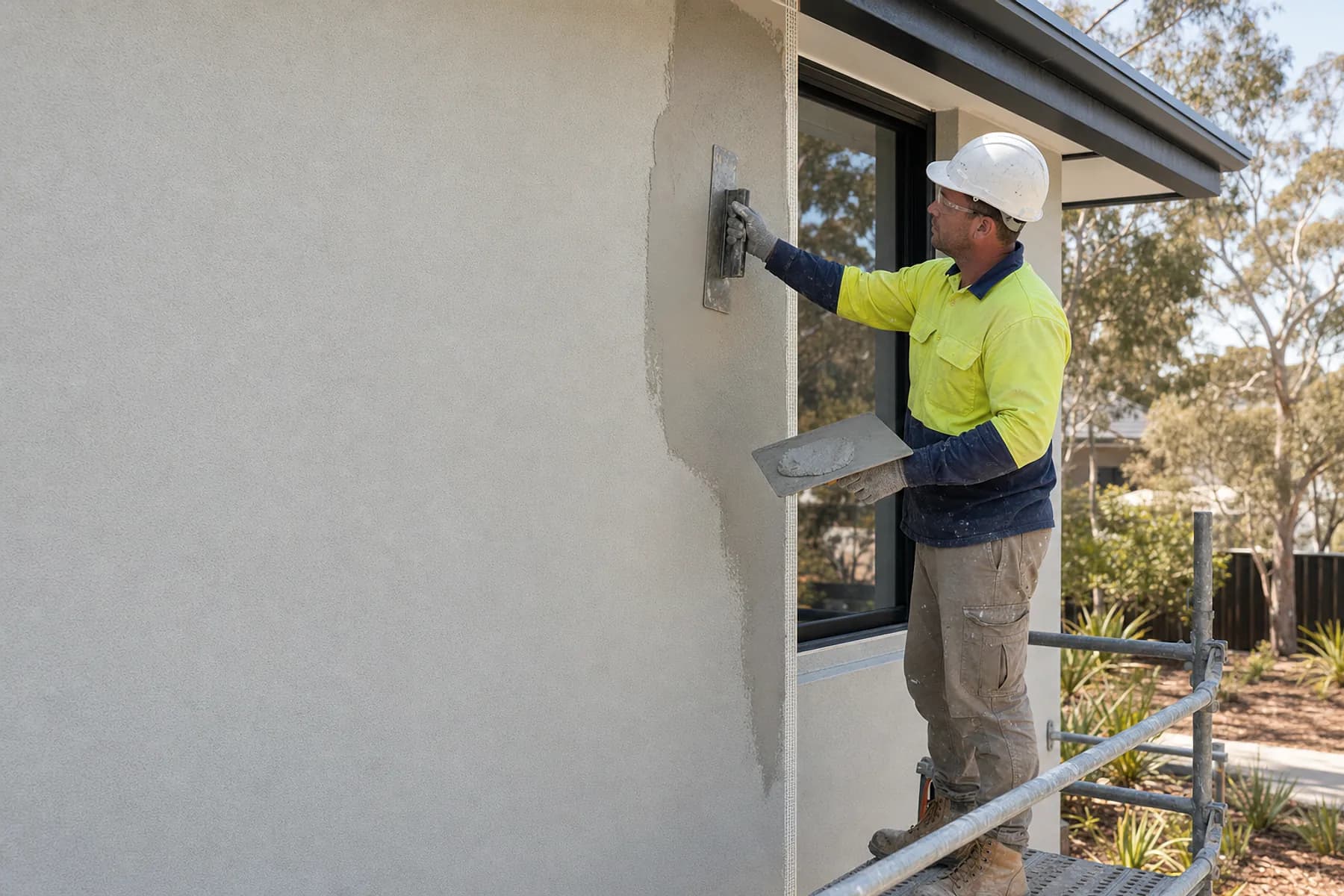
Acrylic Render vs Cement Render: What Should Adelaide Homes Choose?
The short answer
Deciding between acrylic render vs cement render shapes how a wall looks, how it handles movement and how long it lasts before it needs attention—yet plenty of quotes assume the choice has already been made. The two are not interchangeable finishes in different colours: one is a rigid, minerally cementitious base coat, the other a flexible, polymer-modified coating usually applied as part of a coordinated system. Get the choice wrong for the substrate, the exposure or the existing wall, and even a well-applied render can crack, stain or fail early. This guide sets out what separates the two systems and what an Adelaide project should confirm before specifying either.
Acrylic render vs cement render: what actually separates them
Traditional cement render—sometimes called sand-and-cement or solid render—is built from cement, sand and water, mixed to a workable consistency and applied over masonry in one or more coats. It hardens into a hard, minerally bonded layer that becomes part of the wall rather than sitting as a separate skin. Because it is rigid, it does not tolerate movement well: as a substrate expands, contracts or settles, a straight cement render is more likely to develop hairline cracking than a flexible system, particularly where the mix, coat thickness or curing has not followed the specified process.
Where acrylic render differs
Acrylic render—also called polymer render—is a pre-mixed, water-based coating built around acrylic polymers rather than cement alone. Manufacturers such as Rockcote formulate acrylic base coats specifically for surfaces where movement tolerance and adhesion matter, including fibre cement sheeting and previously painted walls, and the polymer content lets the coating flex slightly rather than crack outright under minor substrate movement.
The two are not always a strict either/or choice. Systems such as Dulux Acratex build a cementitious base coat first—to level the masonry and produce an even surface—then finish with a compatible acrylic texture coating over the top, so the finished wall benefits from both the cement base’s strength and the acrylic topcoat’s flexibility and protection. Which combination suits a given wall depends on the substrate, the exposure and the finish specified, so ask your render contractor to confirm the full system—not just the top layer—against the manufacturer’s technical data sheet.
Sources: Rockcote, What Are The Different Types of Render? A Homeowner’s Guide and Dulux Acratex, Acratex Render.
Matching the render system to the wall
Not every wall takes a straight cement render happily, and not every wall needs the flexibility acrylic render provides.
Bare masonry—brick, besser block or stone—is the substrate cement render was developed for; it bonds mechanically into the surface and, correctly cured, becomes a stable base for a topcoat. Fibre cement sheeting behaves differently, moving and flexing with temperature in a way a rigid mix does not accommodate well, which is why Rockcote formulates dedicated acrylic base coats for it rather than a straight cement mix.
Hebel (AAC) panel walls need a coating system matched to the panel manufacturer’s specification and control-joint layout—our guide to rendering Hebel panels in Adelaide covers what that involves. Previously painted brick needs the existing coating’s condition assessed before either render type goes over it, covered in our guide to rendering over painted brick.
Where render is going over an existing rendered or painted wall that is already cracking, the cause needs to be understood before a new coating is applied on top of it. Our guide to render cracking in Adelaide covers the signs that need assessment first.
Why Adelaide conditions matter
Across the Adelaide Plains—through suburbs such as Salisbury, Elizabeth and much of the northern and western suburbs—reactive clay soils mean the ground moves seasonally as it wets and dries, and that movement transmits into footings and walls over time. A flexible acrylic system tolerates that kind of minor, ongoing movement better than a rigid cement render on its own, which is one reason acrylic topcoats are common even over a cement base coat in established Adelaide suburbs.
Coastal exposure changes the calculation again. Homes near Semaphore, Glenelg, Henley Beach and Brighton sit in a higher salt-exposure environment, and the coating’s role shifts toward protecting the substrate from moisture and chloride ingress as much as covering it. Adelaide’s hot, dry summers matter too: a cement-based coat curing too fast in full sun and low humidity is a common cause of shrinkage cracking, so application timing and the manufacturer’s curing guidance matter as much as the product choice itself.
Sources: CSIRO, Foundation Maintenance and Footing Performance and Dulux Acratex, High Performance Coating Solutions overview.
Sensible next steps
Identify the substrate and its condition
Confirm whether the wall is bare masonry, fibre cement, Hebel or an existing coating, and whether that surface is sound enough to render over.
Match the system to the exposure
Check the manufacturer’s technical data sheet for the substrate and exposure combination—coastal salt air and inland heat call for different system specifications.
Confirm the full system, not just the topcoat
The base coat, any reinforcing and the topcoat need to be a compatible, documented system rather than mismatched products chosen on colour alone.
Get the scope and warranty terms in writing
Confirm which applicator is carrying out the work, what system warranty applies, and what upkeep keeps that warranty valid.
- Substrate identified and its condition confirmed before a system is chosen
- Manufacturer technical data sheet for the specific base coat and topcoat combination
- Written confirmation the system suits the property's coastal or inland exposure
- Whether the coating is being installed by a manufacturer-trained applicator
- What warranty applies to the complete system, not just one product
- How the new render meets existing render, cladding or trim junctions
Who should be involved
- Render applicator
- Applies the confirmed base coat and topcoat system to the manufacturer’s specification for the substrate and exposure.
- Manufacturer technical support
- Confirms which base coat and topcoat combination suits your substrate and exposure category, and what warranty applies to the full system.
- Structural engineer
- Needed only where existing cracking suggests ongoing structural movement beyond what a flexible coating is designed to tolerate.
- Elite Surface Group render team
- Assesses the existing wall, recommends a system suited to the substrate and Adelaide exposure, and coordinates preparation through to the finished coat.
Common questions
- Is acrylic render vs cement render really an either/or choice?
- Not always. Many systems use a cementitious base coat with a compatible acrylic texture topcoat over it, so the finished wall benefits from both.
- Which render type costs more?
- It depends on the substrate preparation required, the specified system and the coverage needed, so it is not a fair like-for-like comparison unless you are working from itemised quotes for the same complete scope of work.
- Can render go over Hebel or fibre cement sheeting?
- Yes, with a system matched to that substrate—see our guide to rendering Hebel panels for panel-specific detail.
Sources and further reading
- Dulux Acratex
- Acratex Render and High Performance Coating Solutions overview