Salt Damp in Adelaide Homes: Why Render Alone Will Not Fix It
The short answer
Salt damp is a moisture problem, not a finish problem. Ground water rises through masonry that has no working damp-proof course, carries dissolved salts with it, and leaves them behind as the water evaporates at the wall surface. Rendering over that does not stop the water—it moves the evaporation point further up the wall and often takes the new coating with it. The source has to be found and dealt with before any surface work is worth paying for.
What it looks like
The signs cluster near the bottom of a wall, usually within about a metre of the ground, and they tend to be worse where the wall is shaded or covered.
- A tide mark or band of discolouration running along the lower wall
- White, powdery salt deposits on the brick, stone or mortar surface
- Mortar that has gone soft and can be raked out with a fingernail
- Brick or stone faces fretting, flaking or crumbling away
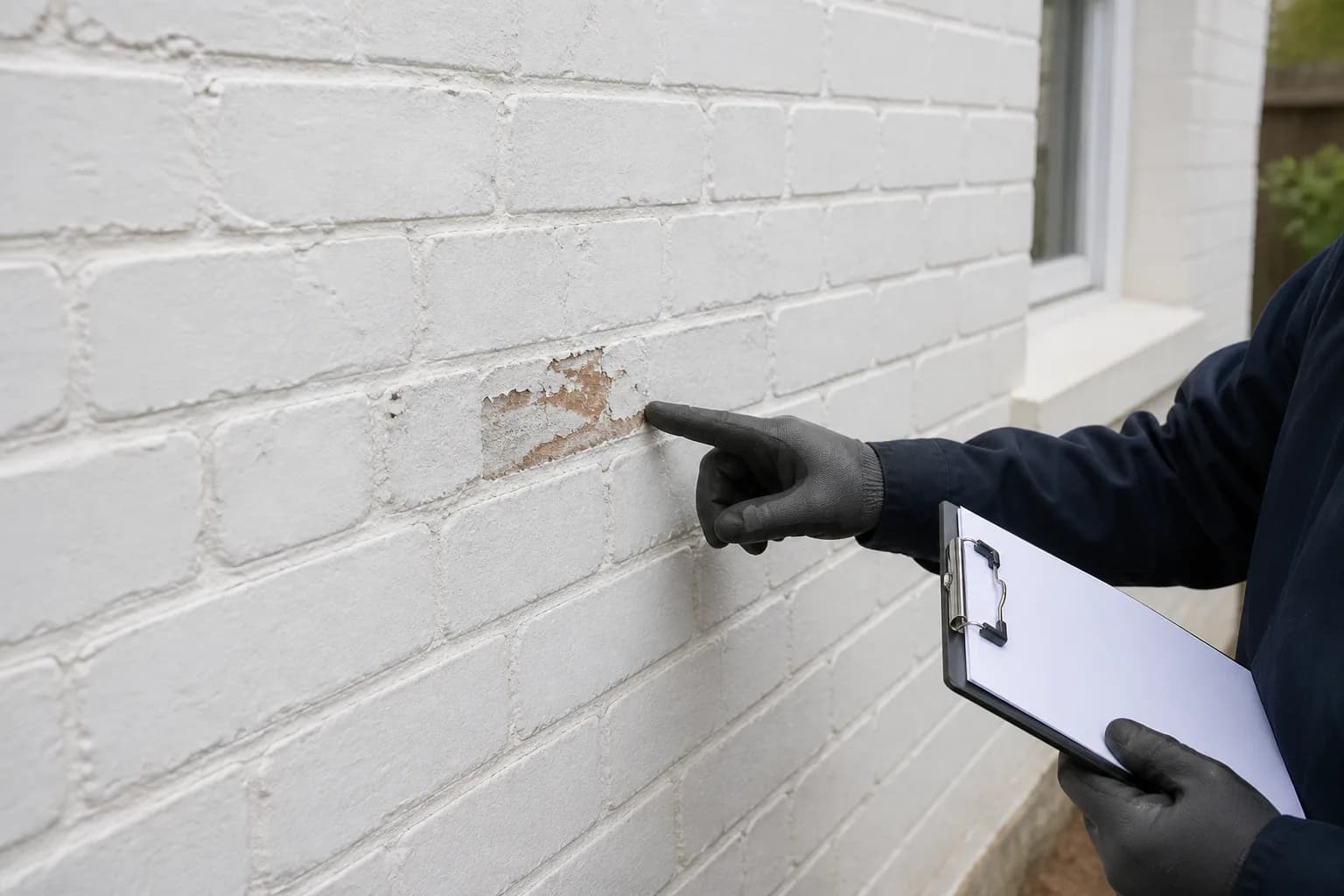
- Paint or render bubbling, blistering and letting go in the same band
- Damp, musty smells and deteriorating skirtings or plaster inside
None of that is proof on its own. Leaking downpipes, a garden bed built up against the wall, a failed shower or a blocked subfloor vent can all produce similar-looking damage, and the fix for each is different. The South Australian Department for Environment and Water publishes a detailed technical guide on salt attack and rising damp that is worth reading before you commission anything.
Why render over salt damp fails
A solid masonry wall built before damp-proof courses were normal relies on being able to dry out. Water that gets in leaves again by evaporating through the face of the brick, stone and mortar. Put a dense, low-permeability coating across that face and the water does not stop arriving—it simply has to leave somewhere else.
What usually follows is predictable. The damp band climbs above the new render. Salts crystallise behind the coating instead of on the surface, and the pressure pushes the render off in sheets. The masonry underneath, now wetter for longer, deteriorates faster than it did before the work. Meanwhile the damage is hidden, so it is found later and costs more.
This is also why coating choice matters so much on older walls. Vapour permeability, not just adhesion, is part of the specification, and the manufacturer’s literature for the selected system sets out where it may and may not be used. Our guide to rendering over painted brick covers the substrate testing side of the same question.
Sources: Government of South Australia, Salt attack and rising damp (PDF) and NCC 2022 Volume Two, Part H2 Damp and weatherproofing.
Why Adelaide sees so much of it
Three things line up here. A large stock of nineteenth and early twentieth century stone and brick housing across the inner suburbs was built before damp-proof courses were standard. The reactive clay soils across the plains hold moisture against footings and move seasonally. And long dry summers drive hard evaporation at the wall face, which is exactly the mechanism that concentrates salt in the masonry.
Coastal suburbs add salt from the air on top of whatever is coming up from the ground. That is also why masonry units carry a durability classification: an exposure-grade unit is the one intended for conditions including attack by salts in ground water below the damp-proof course, and for sea fronts. What is already in an existing wall is a question for the assessment, not an assumption.
Sources: CSIRO, Foundation Maintenance and Footing Performance (PDF) and NCC 2022 Housing Provisions, Part 5.6 Masonry components and accessories.
What actually helps
Remediation works in one order: reduce the water reaching the wall, restore or install a barrier where one is needed, let the wall dry, then deal with the surface. Skipping to the last step is the expensive mistake.
The cheap part comes first, and often does more than people expect. Ground levels built up against a wall, garden beds and irrigation close to the footing, a downpipe discharging beside the house, paving that falls back towards the wall—each of those keeps masonry wet, and each is fixable without touching the wall itself. CSIRO’s guidance on footing performance is direct about how much difference drainage and planting decisions make around an Australian house.
Where a damp-proof course is missing or has failed, the remedy is a specialist trade, not a render trade. The NCC sets out where a damp-proof course sits in new masonry—including minimum heights above adjacent paving or landscaped surfaces—and South Australia carries its own damp-proofing membrane variations. Both matter when the work is being designed, and neither is something a coating substitutes for.
Only once the wall is dry and stable is a finish worth specifying, and on an older building the coating has to suit the masonry rather than the other way around. That is the point at which our Adelaide render services can work to a specification someone else has written, and our planning notes cover what is useful to have ready before that conversation.
Sources: CSIRO, Foundation Maintenance and Footing Performance (PDF), NCC 2022 Housing Provisions, Part 5.7 Weatherproofing of masonry and PlanSA Building Advisory Notice 01/20, Damp-proofing membrane requirements in South Australia (PDF).
Sensible next steps
Photograph the band and date it
Record the affected height on each elevation, inside and out, with something for scale. Whether the band rises, falls or stays put across a season tells an assessor more than a single visit does.
Walk the outside for water sources
Check downpipes, gutters, taps, air conditioning condensate, irrigation, garden beds and paving falls. Note where the ground level sits relative to the floor level inside.
Get the cause assessed, not the symptom
Commission an independent assessment of the moisture source and the wall construction. Ask specifically whether a damp-proof course exists and what condition it is in.
Check the heritage position before anything is removed
If the building is a State or local heritage place, or sits in a heritage area or a contributory item, removing render or altering masonry may need approval. Confirm it before work is scoped, not after.
Sources: Government of South Australia, living in a State Heritage Area, SafeWork SA, crystalline silica substances regulations and SA Health, Managing lead-based paint (PDF).
Common questions
- Will rendering the wall stop the damp?
- No. A coating changes where the moisture leaves the wall, not whether it arrives. On a wall without a working damp-proof course, a dense render commonly pushes the problem higher and then fails along the same band.
- Do we have to remove the existing render?
- Sometimes, and it depends on what is behind it and what the remediation design calls for. On a heritage place, removal may itself need approval. That decision belongs in the assessment, not in a rendering quote.
- How long before the wall can be finished?
- A wall that has been wet for years does not dry in a fortnight, and the drying time depends on the thickness, the masonry, the salt load and the weather. The specialist doing the remediation should set the interval; treat a fixed number offered without an inspection as a warning sign.
Sources and further reading
- Government of South Australia
- Salt attack and rising damp: a guide to salt damp in historic and older buildings (PDF), PlanSA Building Advisory Notice 01/20, Damp-proofing membrane requirements in South Australia (PDF) and living in a State Heritage Area
- Australian Building Codes Board
- NCC 2022 Volume Two, Part H2 Damp and weatherproofing, Housing Provisions Part 5.7 Weatherproofing of masonry and Part 5.6 Masonry components and accessories
- SafeWork SA and SA Health
- Crystalline silica substances regulations and Managing lead-based paint (PDF)