Replacing Asbestos Cladding in Adelaide: What Has to Happen First
The short answer
Replacing asbestos cladding is two jobs with a hard line between them. The first is taking the old sheeting off: licensed, notified, monitored work with its own disposal rules and its own contractor. The second is the new wall—what the frame underneath turns out to be, which system suits the exposure, and how every junction is detailed. We do the second. Until the first is finished and the area cleared, nothing about the replacement can be scoped properly.
Does the house actually have it?
Age is the first filter, and South Australian government guidance puts it in tiers. A home built or renovated before the mid-1980s is highly likely to contain asbestos products; between the mid-1980s and 1990 it is likely; after 1990 it is unlikely. Australia’s total ban on the manufacture, use, import and sale of all forms of asbestos took effect on 31 December 2003, and the national agency estimates asbestos is still present in around one in three Australian homes.
Adelaide’s post-war expansion left a great deal of that era’s housing across the northern and southern suburbs—Elizabeth, Salisbury, Para Hills, Christies Beach—and the inner west. Age is the flag, though, not the suburb.
- Flat or profiled external wall sheeting, often with timber or aluminium cover strips over the joints
- Eaves and soffit lining, gable infill, and sheeting to carports, laundries and garages
- Fencing and roof sheeting of the same era, which often ends up in the same scope
- Bonded (non-friable) sheet behaves differently to friable material, and that difference decides who may remove it
You cannot settle it by looking. The accurate way to find out is inspection and testing by an accredited laboratory, and a sample costs very little next to the cost of assuming wrong. Sheeting that is weathered, drilled, damaged or about to be disturbed is the case for testing sooner rather than later.
Sources: Government of South Australia, find and identify asbestos in the home, asbestos information for homeowners and Asbestos and Silica Safety and Eradication Agency, about asbestos.
Who is allowed to remove it
SafeWork SA licenses asbestos removal by class. A Class A licence covers friable asbestos as well as non-friable material and asbestos-contaminated dust or debris. A Class B licence covers more than 10 square metres of non-friable asbestos. Removal of 10 square metres or less of non-friable material is not licensed work—but unlicensed is not unregulated, and South Australian guidance still recommends engaging a licensed removalist. Anything friable always requires Class A.
Licensed removal carries a process worth understanding as the client. The licence holder must notify SafeWork SA at least five days before the work starts, and the job closes with a clearance certificate, which is not issued unless the removal area and the area immediately around it are free of visible asbestos contamination. That certificate is the document the next trade works from.
Method matters as much as licensing
High-pressure water spray equipment must not be used on asbestos cement: it destroys the binding matrix holding the fibres in the sheet, and SafeWork SA has published incident alerts after exactly that. Power tools, abrasive cutting and sanding discs and compressed air are excluded for the same reason. Hand tools, careful wetting with a low-pressure spray and controlled removal of whole sheets are the accepted approach.
Disposal is regulated separately again. Asbestos waste cannot go into a kerbside bin or a hard-rubbish collection. EPA SA requires it wrapped in manageable packages of thick (200 micron) plastic, sealed at the seams, clearly labelled and taken only to a depot licensed to accept it. Ring the depot first.
Sources: SafeWork SA, asbestos, asbestos licences, notification of asbestos removal, incident alert on high-pressure cleaning and EPA South Australia, Wastes containing asbestos—removal, transport and disposal (PDF).
Replacing asbestos cladding: what the wall underneath decides
Once the sheeting is gone and the area cleared, the frame is visible for the first time in sixty years, and that is when the real scope forms. Homes sheeted in this era are usually timber-framed. Expect some combination of members needing replacement, no sarking, no insulation, and window flashings that were never installed. None of it is visible beforehand, so a fixed price written before removal is an estimate carrying assumptions.
Exposure then shapes the replacement system. Salt-laden air at Semaphore, Glenelg and Brighton is harder on fasteners and coatings than an inland suburb, and durability requirements follow the exposure category rather than the postcode. On the Hills Face side of town, bushfire-prone designation brings its own requirements—our cladding comparison guide explains how that zoning is confirmed, and the coastal maintenance guide covers the upkeep that follows.
Reactive clay soils across the Adelaide plains move seasonally, and a new finish on a frame that is still moving shows it at the joints. Where there is a history of movement, have it understood rather than covered—our guide to cracking in wall finishes sets out what to record.
A rebuilt wall is also the chance to add a membrane and insulation, but those layers interact with drainage and must be designed together: the NCC condensation provisions apply to the whole assembly, not to the boards, and Adelaide sits in climate zone 5.
Sources: NCC 2022 Housing Provisions, Part 10.8 Condensation management, Part 7.5 Timber and composite wall cladding and the ABCB climate zone map, South Australia.
Approvals, scope and sequencing
In South Australia, whether planning consent is needed depends on how the work is categorised. Some work proceeds as accepted development with building consent only, but that category has exceptions—heritage areas and the Hills Face Zone among them—and re-cladding changes a building’s external appearance, which is precisely what a character or heritage overlay concerns. Confirm the position for your allotment before material is ordered.
Sequencing is where these jobs come unstuck commercially. The removalist’s programme, the clearance certificate, any frame repairs and the cladding installation are four separate items, and the scaffold usually spans all of them. Settle in writing who pays for the scaffold, who reinstates downpipes, meter box and taps, who flashes the windows, and what happens to the price if the frame is worse than assumed. A provisional sum for frame repair is a more honest document than a fixed price renegotiated in week two.
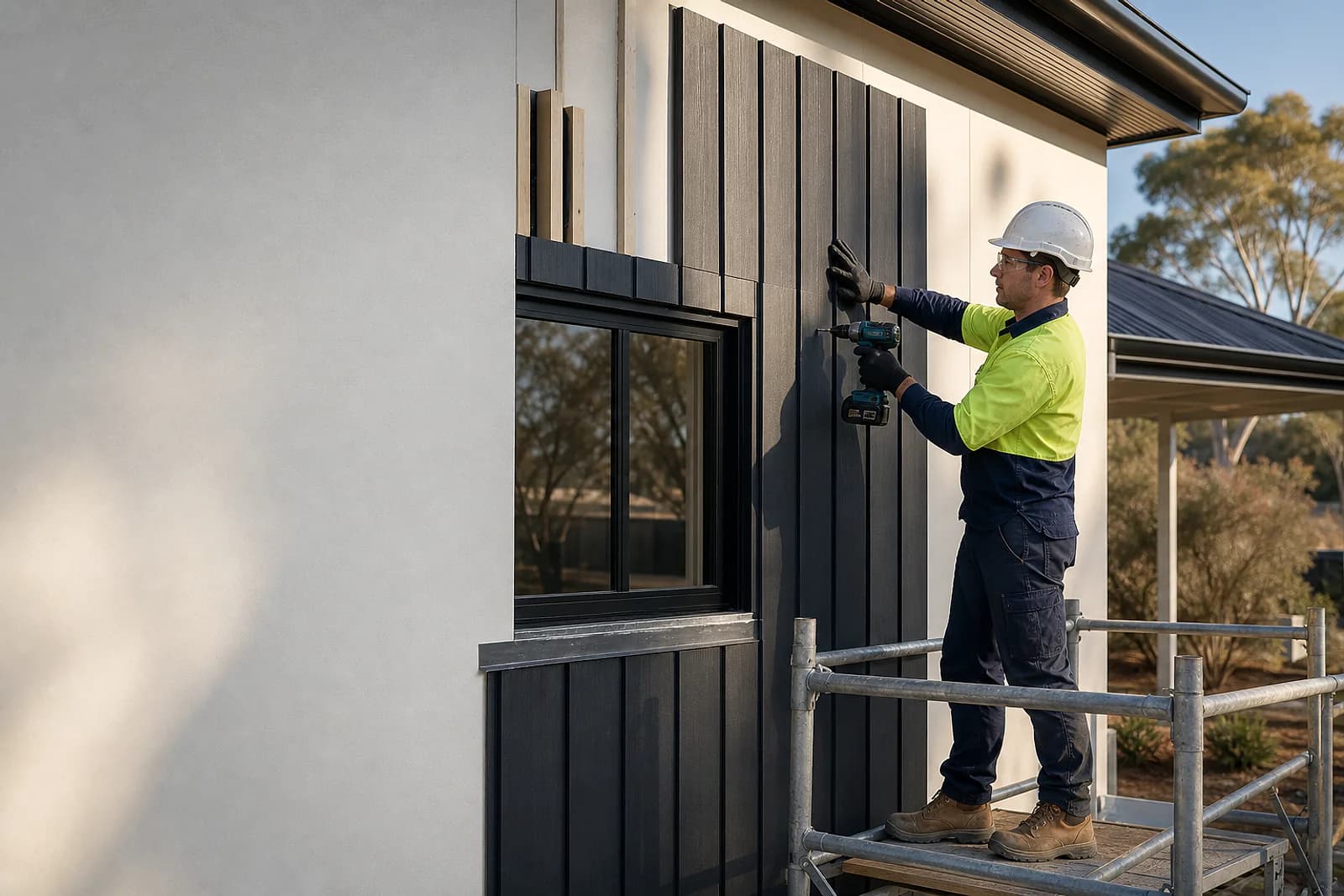
Our Adelaide cladding installation work starts at a cleared, sound substrate, and render is often part of the same elevation where the design mixes finishes. The dark feature cladding case study shows how much the joint layout and corners carry the finished look, our project planning notes list what is useful to have ready before quoting, and the Adelaide service area page covers where we work.
Sources: PlanSA, find out if you need approval and PlanSA, types of consent.
Sensible next steps
Have the material tested
Get a sample analysed by an accredited laboratory before anyone quotes, drills or disturbs the sheeting. The result decides everything that follows.
Engage a licensed removalist directly
Check the licence class against the area and the material, and treat the notification and the clearance certificate as deliverables rather than favours.
Photograph the exposed frame
Once the wall is cleared, record the framing, any damage, window openings and the ground line. That set is what a replacement quote should be priced from.
Confirm the approval pathway
Check the development category and any overlay on your allotment before committing to a material, a colour or a programme.
Sources: SafeWork SA, silica in construction and SafeWork SA, working at heights.
Common questions
- Can new cladding just go over the top of the old sheeting?
- Covering asbestos sheeting leaves it in the building, where it still has to be managed, disclosed and eventually removed, and fixing through it disturbs the material. Where encapsulation is considered at all, it is a decision for a licensed assessor about that wall—not a way to avoid removal.
- Do we have to do the whole house at once?
- Not necessarily. Staging elevation by elevation spreads the cost, but it means paying scaffold and removal mobilisation more than once and living with two finishes in between.
- Will the replacement look like the original?
- Profiles close to mid-century flat sheet and cover strip are available, as are weatherboard and panel systems that change the character entirely. In a heritage or character overlay the external appearance may be assessed, so check that before choosing.
- Who tells the neighbours?
- A licensed removalist manages notification, signage and exclusion zones. Telling adjoining neighbours what is happening and when is still worth doing yourself, especially on a narrow allotment.
Sources and further reading
- Government of South Australia
- Asbestos information for homeowners, find and identify asbestos in the home, PlanSA, find out if you need approval and types of consent
- SafeWork SA
- Asbestos, asbestos licences, notification of asbestos removal, incident alert on high-pressure cleaning, silica in construction and working at heights
- EPA South Australia
- Wastes containing asbestos—removal, transport and disposal (PDF)
- Asbestos and Silica Safety and Eradication Agency
- About asbestos and guidance for householders and home renovators
- Australian Building Codes Board
- NCC 2022 Housing Provisions, Part 7.5 Timber and composite wall cladding, Part 10.8 Condensation management and the South Australian climate zone map
- James Hardie
- Fibre cement product information